Myth and Man
Casanova vs Don Juan: What's the Difference?
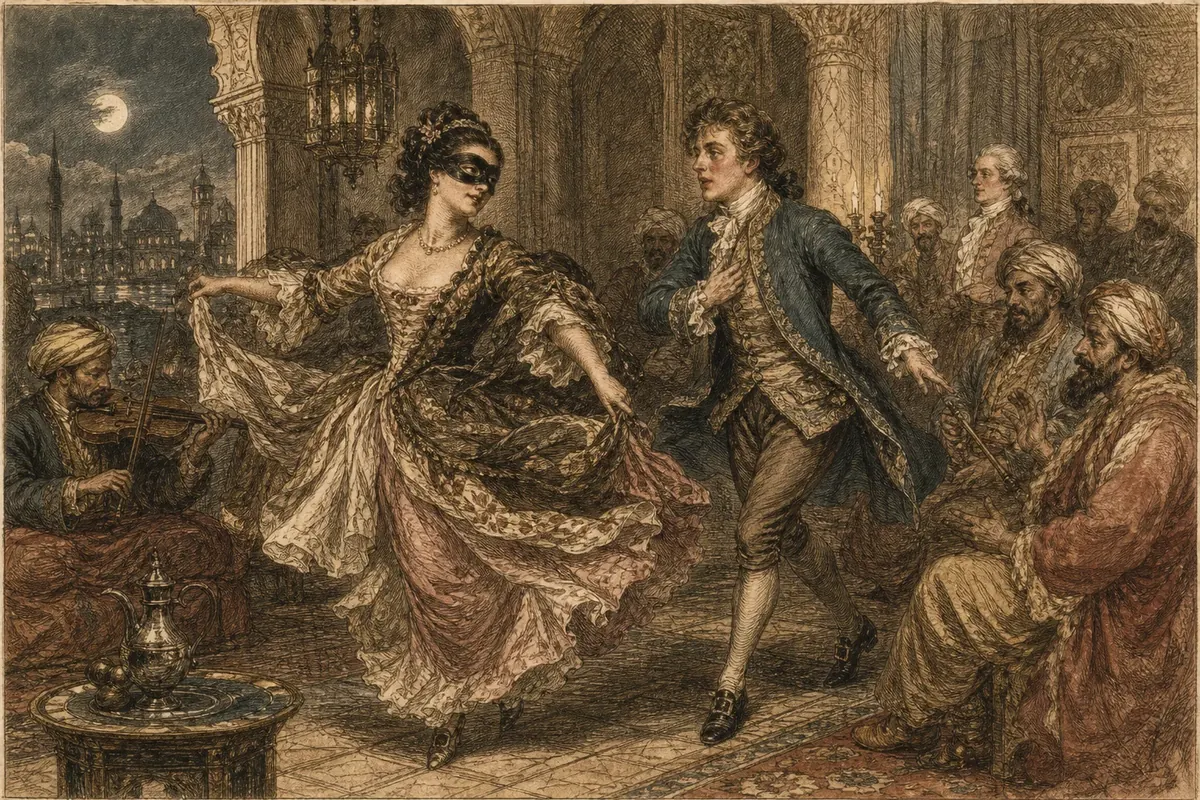
Casanova was a real man who wrote his own life story, while Don Juan is a fictional Spanish libertine who deceives women and is dragged to hell for it. Casanova presents his affairs as mutual and tender and was never punished by a stone statue. The two are linked by Mozart's opera Don Giovanni, which Casanova may have attended.
People often use "Casanova" and "Don Juan" as if they meant the same thing: a man who seduces women. They are very different figures, and the difference tells you a lot about both.
Real man versus fictional character
Giacomo Casanova (1725 to 1798) was a real Venetian adventurer. He was a violinist, a gambler, a spy, a writer and a prisoner, and he wrote a long autobiography, the History of My Life. What we know of him comes mostly from that book and from records and letters that confirm much of it.
Don Juan is a character in a story. He first appears in a Spanish play from around 1630, El burlador de Sevilla (The Trickster of Seville) by Tirso de Molina. The legend was reworked many times, including by Molière, by Lord Byron, and in Mozart's opera Don Giovanni (1787). He never existed.
How their stories end
Don Juan's legend is a moral tale. In the classic version he kills a man, mocks the dead man's stone statue by inviting it to dinner, and is dragged down to hell when the statue arrives. The story condemns him.
Casanova's story has no such ending. He was imprisoned by the Venetian Inquisitors, escaped, was expelled from several cities, and spent his last years as a librarian in a Bohemian castle, where he died of illness. You can read about this in how Casanova escaped from the Leads and in his last years at Dux.
Their attitude to women
The traditional Don Juan is a deceiver. He seduces and abandons, and the story treats him as a villain.
Casanova describes things differently. In his Author's Preface he writes: "I felt myself born for the fair sex, I have ever loved it dearly, and I have been loved by it as often and as much as I could." In the Memoirs his affairs are generally presented as mutual, and he describes loves that last, such as Henriette, whom he remembers as an old man. That is his account, and modern readers will not always agree with it. Some of the episodes he tells are troubling by today's standards.
Another difference is how much else is in the book. Seduction is a small part of a life that includes gambling, travel, business schemes, books and meetings with Voltaire, Frederick the Great and Catherine the Great.
Meet the real Casanova
Skip the legend and read what he wrote. The full Memoirs are in your browser or in the app.
Casanova and Mozart's Don Giovanni
There is a real link between the two. Mozart's Don Giovanni premiered at the Estates Theatre in Prague on 29 October 1787. Casanova was then living at Dux, not far from Prague, and several sources say he travelled there around 25 October and probably attended the premiere.
Some writers go further and suggest that Casanova advised the librettist Lorenzo Da Ponte on the last scenes. The biographer Ian Kelly argues that Casanova's close knowledge of the new text points to this. It is an interpretation, however, and not a documented fact.
Why the confusion?
Casanova's name became a general word for a lover, and Don Juan's name became another. English speakers tend to use "Casanova" as a mildly admiring label and "Don Juan" as a harsher one. If you read the Memoirs, you will find a man who is vain, funny, curious and often selfish, but also far more than a name for a seducer.
Sources
- Casanova, Memoirs, Author's Preface (English translation in this app)
- When Casanova Met Mozart, Smithsonian Magazine
- Don Giovanni, Wikipedia
Meet the real Casanova
Skip the legend and read what he wrote. The full Memoirs are in your browser or in the app.
Related questions
 How Many Women Did Casanova Have? What the Memoirs SayCasanova is said to have had around 120 lovers. Where does that number come from, how reliable is it, and what do the Memoirs actually say about the women?
 Was Casanova Real? Is His Memoir Reliable?Casanova was a real person, and archives confirm much of the Memoirs. Here is the evidence, the early doubts, and where to be careful.