Fact or Fiction
Was Casanova Real? Is His Memoir Reliable?
Yes. Casanova was born in Venice on 2 April 1725 and died at Dux in Bohemia on 4 June 1798. Venetian archives confirm his arrest, imprisonment and escape, and checks of his references to famous people found only a handful of errors. His private stories cannot be verified and he sometimes embellished.
Casanova's life sounds so adventurous that people often ask whether he made it all up, or even whether he existed. He did exist, and a good deal of what he wrote can be checked.
Was Casanova a real person?
Yes. He was born in Venice and baptised in the parish of San Samuele. The baptismal register survives in the archive of the Patriarchate of Venice, which is why his birth date of 2 April 1725 is certain and not just his own word. He died at the castle of Dux in Bohemia on 4 June 1798, aged 73.
What does the evidence say about the Memoirs?
The English edition in this app opens with an essay by Arthur Symons, "Casanova at Dux" (1902). Symons examined the archives in Venice in 1894 and Casanova's papers at Dux in 1899. He reports:
- The imprisonment and escape are documented. In the records of the Inquisitors of State he found the arrest of Casanova, his imprisonment in the Leads, the exact date of his escape and the name of the monk who escaped with him. There are even bills for repairs to the roof and walls of the cell he broke out of.
- Casanova worked for the Inquisitors. The same archives hold 48 letters from him to the Inquisitors, from 1763 to 1782, written in the same hand as the Memoirs. The early ones ask permission to return to Venice, and the later ones are reports as a secret informer.
- His references to famous people check out. F. W. Barthold examined about a hundred of Casanova's allusions to well-known people in 1846. All but six or seven were exact, and only one of those errors seemed to Barthold to be intentional.
- His letters match his stories. At Dux, Symons found letters from women to Casanova that matched the warmth he describes in the Memoirs.
Who doubted the Memoirs?
When the Memoirs first appeared in the 1820s and 1830s, some critics did not believe a man like Casanova could have written them. Ugo Foscolo and the bibliographer Quérard expressed doubts, and Paul Lacroix argued that the real author was the novelist Stendhal. According to Symons, this theory was disproved in 1881 and 1882 by Armand Baschet and Alessandro d'Ancona, who used the Venetian archives and the publisher's records.
Where should you be careful?
- The text was edited. The manuscript, in Casanova's own hand, reached the publisher Brockhaus in Leipzig in 1820. It was published in a German translation with many cuts and then in a French version revised by Jean Laforgue, who smoothed Casanova's French, removed passages and changed names. Symons says he "found scarcely three consecutive sentences untouched" when he compared a passage with the manuscript. The original text was not printed until the 1960s.
- Private stories cannot be checked. Conversations, seductions and secrets rest on his word alone. Casanova wrote the Memoirs decades later, in his seventies, and nobody would expect every detail to be exact.
- He was telling his own story. He had reasons to shine, to settle scores and to leave things out. He admits in the Author's Preface that he omitted adventures that might have offended others.
Judge the Memoirs yourself
Read the Memoirs along with Arthur Symons' essay on the documents he found, in your browser or in the app.
So how reliable are they?
Most scholars treat the Memoirs as broadly reliable on public facts such as people, places and dates, and as a personal, sometimes embellished account of private ones. Symons quotes Casanova's own claim: "Truth is the only God I have ever adored." The documents suggest he was, on the whole, a more careful witness than his reputation implies.
Sources
- Arthur Symons, "Casanova at Dux" (preface to the English edition in this app)
- Casanova, Memoirs, Author's Preface and the appendix (English translation in this app)
- Baptismal register of San Samuele, Venice, as cited in the app's Venice section
Judge the Memoirs yourself
Read the Memoirs along with Arthur Symons' essay on the documents he found, in your browser or in the app.
Related questions
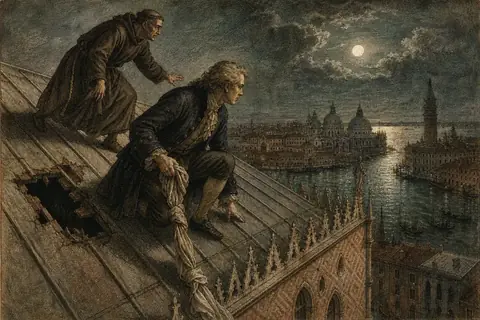 How Casanova Escaped from the Leads Prison in VeniceCasanova escaped Venice's Leads prison on the night of 31 October 1756. Here is how he did it, step by step, from his own account in the Memoirs.
 How Did Casanova Die? His Last Years at DuxCasanova died at Dux Castle in Bohemia on 4 June 1798. How he ended up there, what he did there, what he died of, and where he is buried.