The End of the Story
How Did Casanova Die? His Last Years at Dux
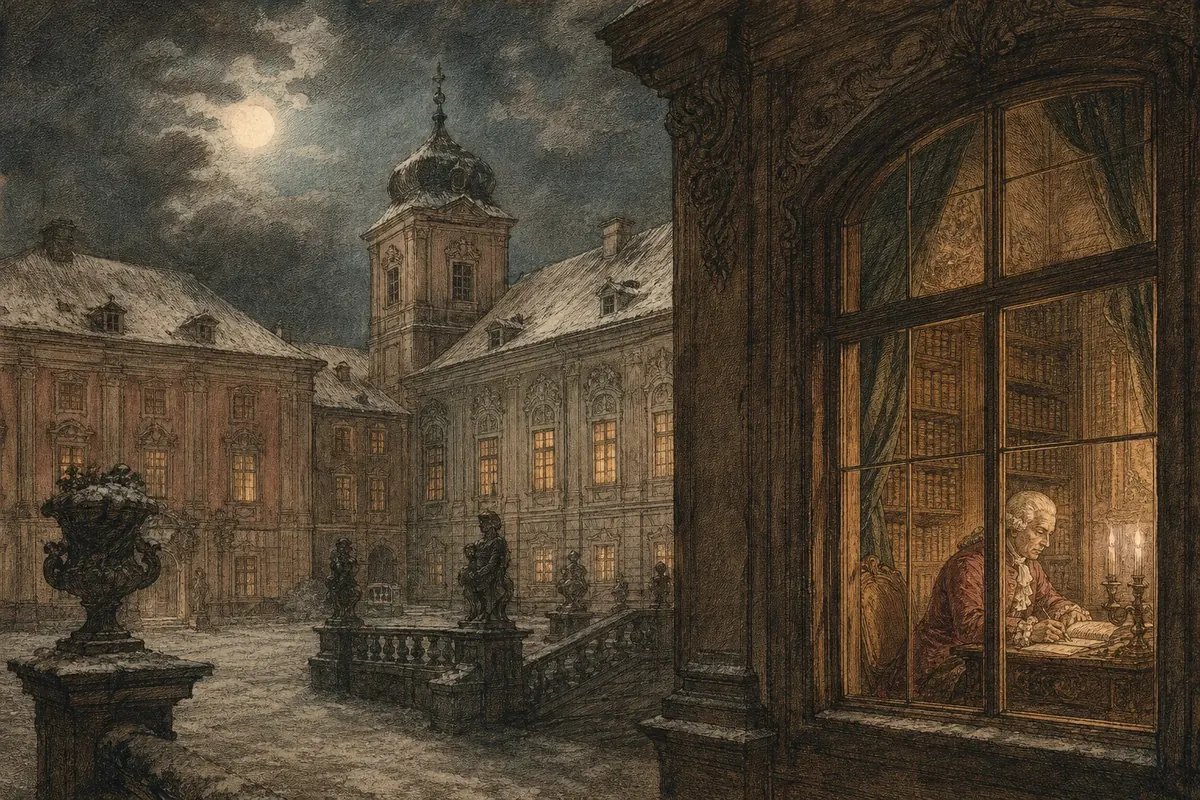
Casanova died on 4 June 1798 at Dux Castle in Bohemia, aged 73. Letters show he fell gravely ill in February 1798 with a bladder complaint and suffered for about three and a half months. He had lived there for almost 13 years as Count Waldstein's librarian and wrote the Memoirs in that time.
For a man who crossed Europe for decades, Casanova's final home was an unlikely one: a Bohemian castle, in a small town far from Venice. It was there that he died, and also there that he wrote the Memoirs.
How did Casanova end up at Dux?
By the early 1780s his life in Venice had gone wrong. He had worked for the Inquisitors as a secret informer after his return in 1774, but in 1782 he fell out with the Venetian nobility and left the city at the turn of 1782 to 1783. After spells in Vienna and Paris he looked for a post and a place to live.
In Paris in 1784 he met Count Waldstein at the Venetian ambassador's, and the Count invited him to be his librarian at Dux. In September 1785 Casanova was at Teplitz, where he found the Count and accompanied him to the castle at Dux. He remained there almost constantly, in charge of the library and on a pension of 1,000 florins a year.
What was life at Dux like?
Arthur Symons visited in 1899 and described the castle as "like a royal palace", with a library of about 25,000 volumes that Casanova had arranged. The papers that Symons found show a restless mind that never stopped working:
- Casanova wrote ten or twelve hours a day, which he said was the only way to keep "black melancholy" from devouring him.
- He wrote comedies for Count Waldstein's neighbours, mathematical treatises, philosophical dialogues, letters to many correspondents, and several published books.
- He began the Memoirs around 1789 and was still revising the twelve volumes in 1797.
He was not content. In a note from those years he complains that Dux is called a delightful spot, "but not for me". In another passage, quoted in the app's appendix, he writes: "Cursed old age, thou art only worthy of dwelling in hell."
In 1797 he lost three chapters of the Memoirs when a servant girl at Dux took the pages, which were covered with erasures, for her own use. He had to rewrite them. On 17 November 1797 he wrote a short Summary of My Life for a correspondent. It ends: "Count Waldstein stopped me at Teplitz and led me to Dux where I still am and where, according to all appearances, I shall die."
Read the Memoirs he wrote at Dux
The twelve volumes he wrote in a Bohemian castle, in your browser or in the app, along with the appendix on his last days.
How did Casanova die?
According to the letters collected in the app's appendix, Casanova became ill in early February 1798 with "a very grave bladder trouble of which he died after suffering for three-and-a-half months." Friends wrote to him throughout his illness. On 31 March, one of them sent a box of medicines after consulting a doctor. On 6 May another correspondent wrote that she could not send some crawfish soup because the rivers were too high for the peasants to catch crawfish.
He died on 4 June 1798. His reported last words, attributed to his friend the Prince de Ligne and to other witnesses, were: "I have lived as a philosopher, and die as a Christian."
Where is he buried?
Casanova was buried in the churchyard of St Barbara's church at Dux (now Duchcov, in the Czech Republic). The exact location of the grave is uncertain. Accounts mention a tablet with his name on the church wall, and one Czech guide reports that a cross placed over the grave was later removed.
What happened to the Memoirs?
Casanova died without seeing them published. Twenty-two years later, in 1820, a man called Carlo Angiolini brought the manuscript to the Leipzig publisher Brockhaus. It is titled History of My Life up to the year 1797, but it breaks off in 1774.
Sources
- Appendix to the English Memoirs ("The Castle at Dux", "Summary of My Life", "Last Days at Dux"), in this app
- Arthur Symons, "Casanova at Dux" (preface in this app)
- The Death of Casanova, History Today
- Casanova: the world-class lover who died a second-rate librarian in Bohemia, Radio Prague International
Read the Memoirs he wrote at Dux
The twelve volumes he wrote in a Bohemian castle, in your browser or in the app, along with the appendix on his last days.
Related questions
 Was Casanova Real? Is His Memoir Reliable?Casanova was a real person, and archives confirm much of the Memoirs. Here is the evidence, the early doubts, and where to be careful.
 Casanova's Journey Across Europe: A City-by-City TimelineA year-by-year timeline of Casanova's travels: Constantinople, Paris, London, St Petersburg, Madrid and finally Dux, with the reason for each trip.