The Great Escape
How Casanova Escaped from the Leads Prison in Venice
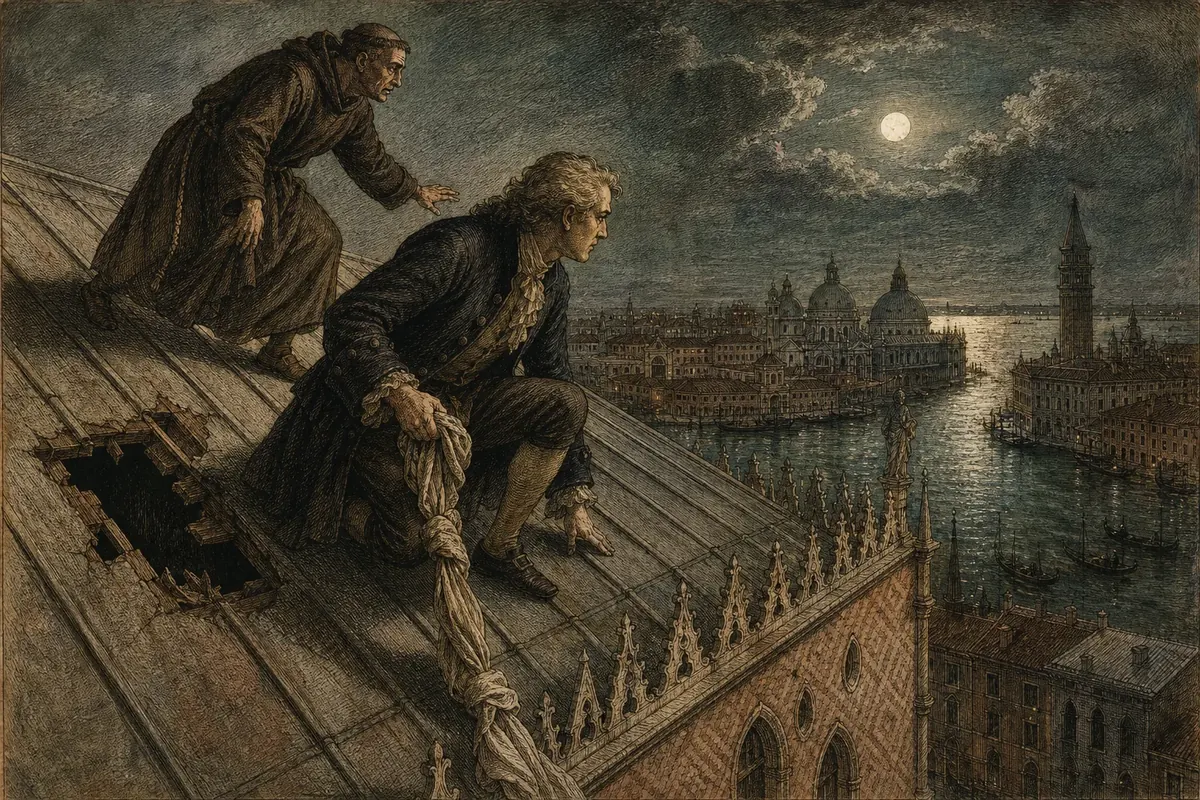
Casanova broke out of the Leads, the prison under the roof of the Doge's Palace in Venice, on the night of 31 October 1756. A fellow prisoner, Father Balbi, cut a passage to his cell using a sharpened iron bolt. The two then climbed onto the roof, entered the palace through a dormer window and left by gondola.
Casanova's escape from the Leads is the most famous episode of his life, more famous than any of his love affairs. It is also the part of the Memoirs that reads most like a thriller, and he told it in careful detail.
Why was Casanova in the Leads?
The Leads (i Piombi in Italian) was a prison in the attic of the Doge's Palace, named after the lead sheets that covered its roof. Cells there were reserved for prisoners of the Venetian Inquisitors of State, who ruled in secret.
In July 1755 the Inquisitors had Casanova arrested and shut up in the Leads. He was not given a public trial and, by his own account, never learned the exact charge. Biographers usually link it to accusations of immorality, impiety and suspected dealings in magic. Standard accounts give his sentence as five years. In the Memoirs, he says the Inquisitors' secretary announced his fate to him in Tuscan Italian, and that he spent the following months trying to work out why.
By his own count he spent about fifteen months in the Leads before he got out.
What was the Leads like?
The lead roof turned the cells into ovens in summer. In the Memoirs, Casanova describes his confinement and a jailer named Lorenzo (spelled "Lawrence" in the English translation in the app) who controlled his daily life.
Two details turned out to matter. First, Lorenzo allowed him to walk in the attic above the cells to keep his health. Second, he was later moved to a new cell, and the guards did not sound the ceiling when they checked it, unlike the walls and floor.
Read the escape in Casanova's own words
The escape fills chapters XXVI to XXXI of the Memoirs. Read them in your browser or in the app, and play the interactive Escape from the Leads.
The plan: an iron bolt, a priest and a hole in the ceiling
The escape began in the attic. Casanova found an iron bolt there and sharpened it into a pointed tool he calls his pike. With it he could dig, but there was a problem: his new cell was new and clean, and any scratch would show.
The solution came from a neighbour. Casanova began writing to another prisoner, Father Balbi, a priest who was locked in a different cell. Casanova found a way to pass him the pike, and Balbi used it to cut a passage through his own ceiling and toward the ceiling of Casanova's cell. According to the Memoirs, the monk reported that the passage was ready and that he needed only a few minutes to break through the last board.
Casanova also had to deal with a cellmate named Soradaci, whom he describes as a spy and a scoundrel. He made Soradaci swear an oath of silence and kept watch on him until the moment came.
The night of the escape
The plan was set for the night of 31 October 1756. In the chapter where he breaks out, Casanova notes that midnight struck and that the new day was All Saints' Day. Later, waiting in the palace, he is thinking about the day's date:
"I do not know whether those who sweep out the palace will come here to-day, which is All Saints' Day, or tomorrow, All Souls' Day. If anyone comes, I shall run out as soon as the door opens, and do you follow after me…"
The route, as he tells it:
- Balbi broke through the ceiling of Casanova's cell, and the two men gathered their rope and bundles.
- They climbed onto the steep, slippery lead roof of the palace. Casanova pulled the monk up while crawling on the roof himself.
- Casanova explored the ridge for a long time looking for a place to fix the rope, and finally found a dormer window.
- Using the pike, he removed the grating and broke the window, then lowered Balbi and himself into a loft.
- They went through a gallery of state archives, down short flights of stairs, and into the ducal chancery.
- He found an iron tool on a desk and used it to break a hole in the chancery door.
They waited in the palace until morning, then left, took a gondola and told the gondoliers to row to Fusina. Casanova writes that the sun was rising and that it was a glorious morning as they crossed toward the mainland. By the time they reached Mestre they were on land.
What happened next?
Reaching the mainland did not end the danger. In Mestre, Casanova recognised a man who was rumoured to work for the Holy Office, and he feared being arrested at once. The two went on to Treviso and then on foot toward the border at Borgo Valsugana, the first town beyond the Republic's territory.
Balbi was a burden. He kept reminding Casanova that he would never have got out without him, and in the end the two went their separate ways. Casanova travelled on to Munich and then to Paris, where he arrived in time to witness the attempt on the life of Louis XV in January 1757.
In 1788, years after the escape, Casanova published a separate short account of it, the Histoire de ma fuite. The version in the Memoirs is longer and more detailed.
Is Casanova's account true?
The imprisonment and the escape are not just Casanova's story. Arthur Symons, who examined the Venetian archives in 1894, reports in his essay in the English edition that the records of the Inquisitors of State document his arrest, his imprisonment in the Leads, the exact date of his escape and the name of the monk who escaped with him. The archives even contain the bills for repairs to the roof and walls of the cell he broke out of.
The fine details, such as the exact route over the roof or what Balbi said, come from Casanova's own telling and cannot be checked independently. He wrote the Memoirs decades later, so some embellishment is possible. Popular summaries also disagree on small points, including who escaped with him. For more on the evidence, see Was Casanova real? Is his memoir reliable?
Sources
- Casanova, Memoirs, Volume 10, "Under the Leads": Project Gutenberg
- Chapters XXVI to XXXI of the English translation in this app
- Arthur Symons, "Casanova at Dux" (preface in this app), on the Venetian archive records
Read the escape in Casanova's own words
The escape fills chapters XXVI to XXXI of the Memoirs. Read them in your browser or in the app, and play the interactive Escape from the Leads.
Related questions
 Was Casanova Real? Is His Memoir Reliable?Casanova was a real person, and archives confirm much of the Memoirs. Here is the evidence, the early doubts, and where to be careful.
 Casanova's Venice: Where He Was Born, Played and JailedA guide to the Venice of Giacomo Casanova: the parish where he was born, the gambling room, the palace prison he escaped from, and what survives today.
 Casanova's History of My Life: Summary and Reading GuideWhat is Casanova's History of My Life about? A plain summary of the Memoirs, volume by volume, with the episodes worth reading first.