The City
Casanova's Venice: Where He Was Born, Played and Jailed
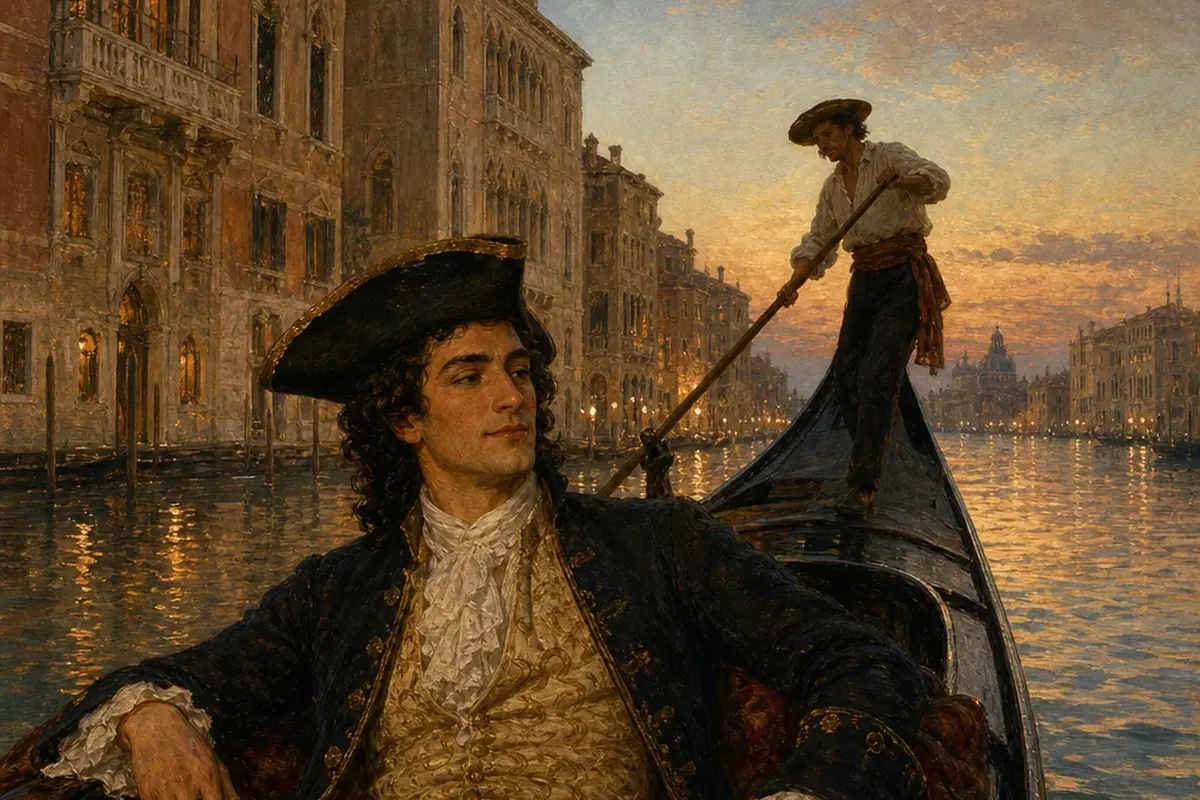
Casanova was born in the parish of San Samuele in Venice on 2 April 1725. His Venice includes the Piazza San Marco, the Ridotto gambling room, Caffè Florian, and the Doge's Palace, where he was held in the Leads from 1755 to 1756. Several of these places can still be visited. The Teatro San Samuele was demolished, and the Ridotto was closed in 1774.
Casanova left Venice and came back several times, and the city runs through the Memoirs. Here is a guide to the places that matter in his story, with what is known and what is only tradition.
Where was Casanova born?
Giacomo Casanova was born in Venice on 2 April 1725, the first child of two theatre people. His father, Gaetano, danced and acted. His mother, Zanetta Farussi, was the daughter of a Venetian shoemaker and became a celebrated actress. The family lived in the parish of San Samuele, close to the theatre of the same name, and Giacomo was baptised in the parish church on 5 April 1725.
The baptismal register of San Samuele survives in the archive of the Patriarchate of Venice. Tradition places the family home on the Calle della Commedia, today the Calle Malipiero, a few steps from the Grand Canal, but the exact house is not documented. The Teatro San Samuele itself was pulled down in the 19th century.
His parents were often away on tour. After his father died in 1733 his grandmother Marzia raised him. He studied in Padua, took a doctorate in law at sixteen, in 1742, and returned to Venice.
The places in his story
- Piazza San Marco. The basilica, the bell tower and the arcades were the stage of Venetian public life: processions, Carnival, and cafés where news and gossip travelled.
- Caffè Florian. Open since 1720, five years before Casanova was born, and still open on the square.
- The Ridotto. Opened by the state in 1638 at San Moisè, it let masked nobles gamble under supervision. Casanova played here and, as the app's guide puts it, won and lost a good deal. The Great Council closed it in 1774.
- The Doge's Palace and the Leads. This was the seat of the Doge, the Great Council and the State Inquisitors. Under its lead roof were the cells known as the Leads, where Casanova was held in 1755 and from which he escaped in 1756. The full story is in How Casanova escaped from the Leads.
- The Bridge of Sighs. It was built around 1600 and joins the palace to the new prisons. Its romantic name was added by later writers. Casanova's own cell was in the palace attic, not across the bridge.
- The Rialto, the Arsenale and the Pietà. The Rialto was the commercial centre. The Arsenale was the great shipyard. The Pietà housed orphan girls who were trained as musicians, and Vivaldi taught there.
- Ca' Rezzonico. A Grand Canal palace finished in the 1750s, now the museum of Venice in the 1700s, with period rooms and paintings by Tiepolo and Guardi.
Explore Venice in the app
The app has a Venice map with the places in this guide, and the Memoirs begin and return there.
Venice in his life: a timeline
- 1725. Born in San Samuele.
- 1755. Arrested by the State Inquisitors and imprisoned in the Leads.
- 1756. Escapes on the night of 31 October to 1 November and flees the Republic.
- 1774. Is allowed back. He arrived in Venice on 14 September 1774, after about nineteen years away, and later called it "the most pleasant moment of my life."
- 1774 to 1782. Works as a secret informer for the Inquisitors, according to the archives.
- 1782 to 1783. Falls out with the Venetian nobility and leaves for good.
- 1798. Dies at Dux in Bohemia, a year after the Republic itself had ended.
What can you still see?
The Doge's Palace, the Piazza San Marco, Caffè Florian and Ca' Rezzonico can all be visited, and the parish of San Samuele is still on the map. The theatre where his parents worked no longer exists.
Sources
- Venice section of the app: birth facts, the baptismal register at the Patriarchate archive, and the places listed above
- Casanova, Summary of My Life (appendix) and Arthur Symons, "Casanova at Dux" (English edition in this app)
Explore Venice in the app
The app has a Venice map with the places in this guide, and the Memoirs begin and return there.
Related questions
 How Casanova Escaped from the Leads Prison in VeniceCasanova escaped Venice's Leads prison on the night of 31 October 1756. Here is how he did it, step by step, from his own account in the Memoirs.
 Casanova's Journey Across Europe: A City-by-City TimelineA year-by-year timeline of Casanova's travels: Constantinople, Paris, London, St Petersburg, Madrid and finally Dux, with the reason for each trip.